
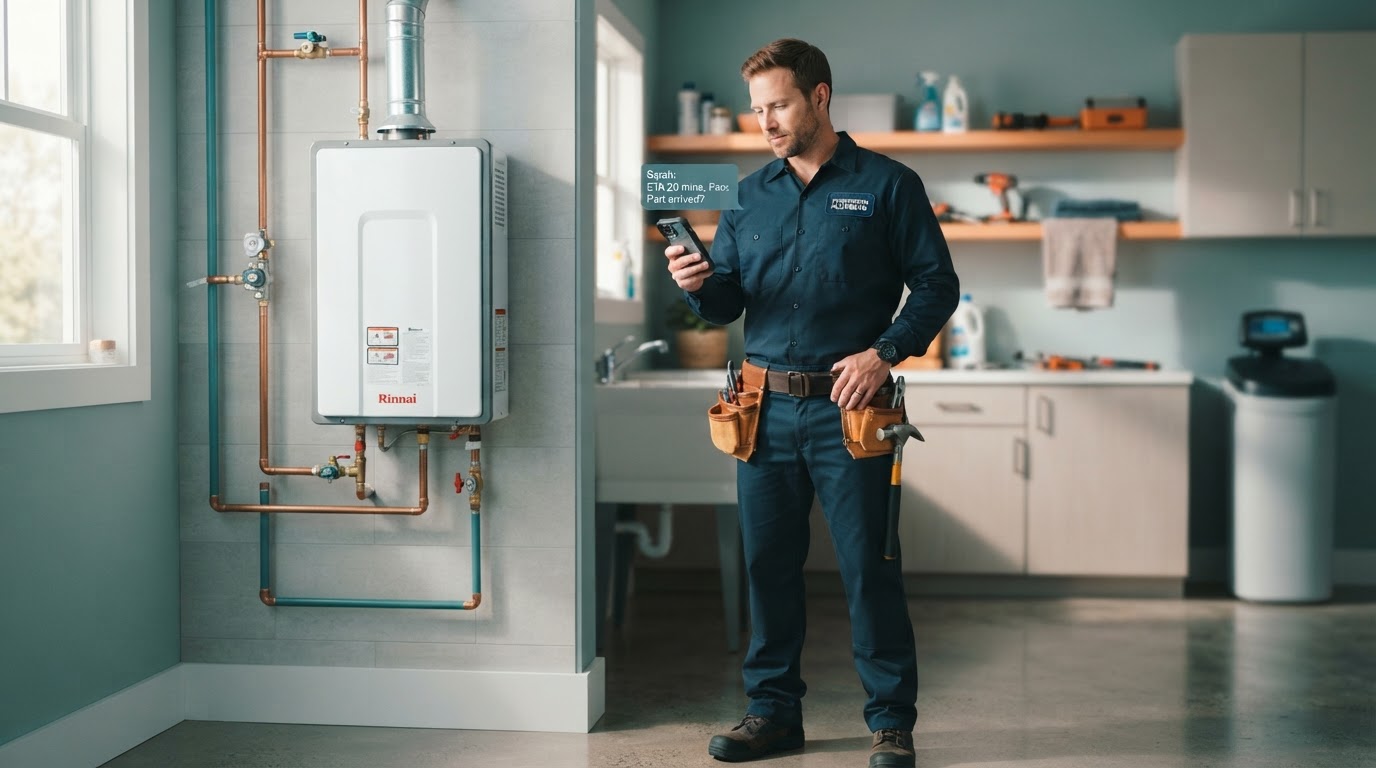
Plumbing jobs slip away when you're under a sink and can't answer. Here's how to text back within a minute, qualify the job, and book it on your calendar.
When you are under a sink or driving to the next job, the phone rings and you can't answer. That call usually goes to the next plumber on Google. This guide is about the calls you miss during the workday while you are on a job. For after-hours and emergency calls, see our guide on how plumbers stop missing emergency calls. Here's how to build a system that catches those mid-job calls, and how to judge any provider before you pay.
Why do missed calls cost plumbers jobs?
A homeowner with water on the floor doesn't leave a voicemail and wait. They hang up and call the next plumber on Google. Whoever responds first usually gets the job.
Speed matters even outside emergencies. In a Harvard Business Review study of online sales leads, firms that tried to contact a lead within an hour were nearly seven times as likely to qualify it as firms that waited even an hour longer (The Short Life of Online Sales Leads, HBR). That study covered web leads across many industries, not plumbing calls, but the lesson carries over: the longer a customer waits, the colder they get.
Start by finding out how big your leak is. Pull your phone logs for the last 90 days and count the calls that went to voicemail or hung up, then multiply by your average job value.
What is the 7-step system to stop losing jobs from missed calls?
1. Decide who answers, and what happens when they can't
Write down your call flow for business hours, for when everyone is on a job, and for after hours. What matters is the last step. A call should never end at a full voicemail box. If nobody picks up, it should trigger the next step automatically.
2. Text back within a minute
Most callers won't leave a voicemail, but most will answer a text. Set up an automatic text that goes out within a minute of any missed call, on your existing business number. Keep it short and human. For example: "Hi, this is [Your Company]. Sorry we missed your call! What issue are you having? We can get someone out to you." A fast text tells the customer you're on it.
3. Qualify the issue, the address, and the urgency
The text conversation should collect what your dispatcher needs before anyone calls back: what's wrong, the service address, and how urgent it is. For plumbing, the useful questions are simple. Is water actively running? Where in the house? Do you know where the shutoff is? A dripping faucet and a burst supply line need very different responses, and you want to know which one you have before you roll a truck.
4. Book it straight onto your calendar
A lead written on a sticky note is a lead you can lose. Once the job is qualified, it should be booked into the scheduling software you already run, with the customer's details and the conversation attached. If someone has to retype it later, it will get skipped on your busiest day.
5. Send emergencies to a person, fast
Automation should never be the only thing standing between a flooding basement and your crew. Decide what counts as an emergency (active flooding, a burst pipe, a sewage backup, a gas smell) and make sure those conversations trigger an immediate alert to whoever is on call. The text-back buys you time and gathers the details. A person makes the call.
6. Follow up with anyone who goes quiet
Some customers won't reply to the first text. Send one follow-up a couple of hours later, and if there's still no answer, put the lead in front of a person to call. Most jobs lost to missed calls are lost here, in the silence after the first touch.
7. Measure booked and completed jobs, not just calls
Track the whole chain every week: missed calls, text-backs sent, replies, jobs booked, jobs completed, and revenue from those jobs. If missed calls are going down but booked jobs aren't going up, something in steps 3 through 6 is broken.
Answering service, text-back, or done-for-you agency: which is right for your shop?
There are three common ways to cover missed calls. None is right for every shop, and many shops combine them.
| Option | What it does | Strengths | Watch out for | Best fit |
|---|---|---|---|---|
| Answering service (live or AI) | Answers your calls when you can't | The caller reaches a voice right away; can cover nights and weekends | Some only take messages and don't book; pricing per call or per minute adds up in busy months | Shops that want a voice on every call |
| Missed-call text-back tool | Texts the caller automatically after a missed call | Low cost, quick to turn on, works on your existing number | You write the messages, set up booking and follow-up, and someone has to work the replies | Shops with office staff who can handle text conversations |
| Done-for-you agency | Sets up and runs text-back, qualifying, booking, and follow-up for you | No setup work for you; tuned to your trade and your software | Costs more than a DIY tool; check contract terms and who owns your data | Owners who don't have time to build and maintain it |
What should you test before you hire any missed-call provider?
Whoever you're considering, test it like a customer would before you sign:
- Call your business number after hours, let it ring out, and time how long the text-back takes.
- Play the part of a homeowner with a burst pipe. Does a real person on your team get alerted within minutes?
- Check that the booked job shows up in your scheduling software with the address and notes, without anyone retyping it.
- Ask what happens when the customer doesn't reply to the first text.
- Ask for reporting on booked and completed jobs, not just calls answered or texts sent.
- Confirm it works on your existing phone number.
- Ask about contract length, how to cancel, and who owns your customer data if you leave.
How does BehindTheTools.ai handle missed calls for plumbers?
BehindTheTools.ai builds and runs done-for-you growth systems for plumbing contractors. We set up and run the system above for you. When a call is missed, the customer gets a personalized text in under a minute. The AI qualifies the job type, address, and urgency, then books the job onto your calendar. Emergencies like flooding are flagged and pushed to your dispatch phone so a person can call back right away. If the customer doesn't reply, the AI follows up after 2 hours, and if there's still nothing, it flags the lead for your dispatcher to call. When you send a quote, the system follows up so it doesn't go cold. Every conversation is logged in your CRM, and it all works on your existing number through call forwarding.
We handle the setup, prompt engineering, CRM connection, and phone line routing. Most shops go live in 3 to 4 weeks; exact timing depends on your phone and CRM setup. There are no long-term contracts.
See how it works for plumbing shops on our AI for plumbing contractors page, read more about missed call recovery, or start at the BehindTheTools.ai homepage to book a free AI Checkup. Explore AI systems for plumbing shops to see the full setup. If after-hours emergencies are your biggest leak, read How to Stop Missing Emergency Calls as a Plumber.
What results does this get in a real shop?
JK Quality Electric booked 13 jobs worth $12,400 in its first 30 days after setting up missed-call text-back, AI booking, and customer reactivation with BehindTheTools.ai.
Frequently Asked Questions
What should I text a customer after a missed call?
Keep it short and human, and ask for what you need to book the job. For example: "Hi, this is [Your Company]. Sorry we missed your call! What issue are you having? We can get someone out to you." Then collect the problem, the service address, and how urgent it is.
How fast should I respond to a missed call?
As fast as you can, ideally within a minute. A homeowner with a plumbing problem is usually calling other plumbers too, and an automatic text-back on your business number can reach them while you're still on a job.
Is a missed-call text-back better than an answering service?
It depends on your shop. An answering service gets a voice on the line, but some only take messages. A text-back tool is cheaper and quick to set up, but someone has to work the replies and book the jobs. Many shops use text-back for overflow and after hours, with a person handling emergencies.
Can missed-call text-back book jobs into my scheduling software?
It can if it's connected to your software. Ask any provider to show you a test job landing in your calendar with the address and notes attached, without anyone retyping it.
How do I know if my missed-call system is working?
Track booked and completed jobs, not just calls answered or texts sent. Each week, compare missed calls, text-backs sent, replies, jobs booked, and jobs completed. If missed calls drop but booked jobs don't rise, fix the qualifying, booking, or follow-up steps.
Put This Into Action
Turn what you just read into recovered revenue. Explore the AI systems behind these results:

Shaun Steckler is the founder of BehindTheTools.ai. For over 23 years he hired and managed plumbers, HVAC techs, and electricians, and watched the best ones lose jobs to missed calls and quiet customer lists. He built BehindTheTools.ai to put done-for-you AI growth systems behind trade contractors so they stay booked out without hiring more people.
Read more from Shaun Steckler